
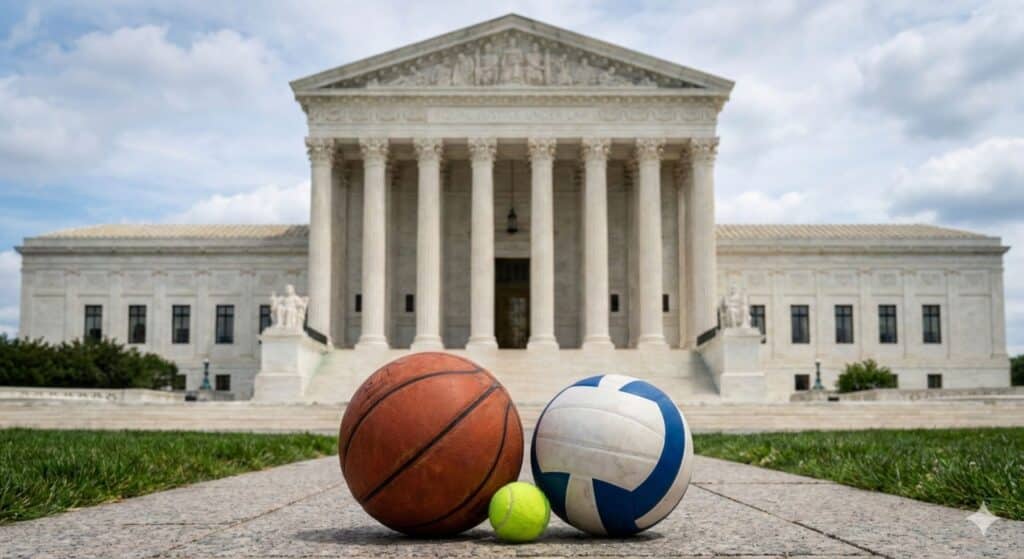

Today, the Supreme Court heard two cases: Little et al. v. Hecox, and West Virginia et al. v. B.P.J. Both cases addressed the issue of whether states can ban transgender athletes from participating in women’s and girls’ sports. The Fourth and Ninth Circuits previously struck down bans in West Virginia and Idaho, respectively, citing Title IX and the Fourteenth Amendment’s Equal Protection Clause. Idaho and West Virginia took their appeals to the highest court in the nation, where they expect a ruling later this spring.
What does this mean for student athletes? Let’s break it down.
Title IX History and Supreme Court Oral Argument
Title IX of the Education Amendments of 1972 (“Title IX”) prohibits discrimination based on gender in federally funded educational programs and activities, including athletics.
In 1974, Congress enacted the Javits Amendment instructing the old Department of Health, Education, and Welfare (HEW) to propose regulations regarding Title IX’s applicability to athletics. Title IX’s implementing regulations prohibiting sex-based discrimination in athletics became final a year later in 1975.
In oral argument today, the Supreme Court asked Idaho and West Virginia what the definition of “sex” is under Title IX. The states argued that the definition of “sex” under Title IX is limited to the definition of “sex” when Title IX was enacted in 1972 and that “sex” is defined as “biological sex.” The student athletes argued that Title IX’s definition of “sex” is expansive enough to include gender identity.
What Could Change
It is expected that the Supreme Court will release their final opinion in late spring. If the Supreme Court rules that Title IX’s definition of “sex” includes gender identity, transgender sports bans will fall. If the Supreme Court limits Title IX’s definition of “sex” to its original definition in 1972, the bans will continue. However, it remains to be seen how any ruling will affect those states with anti-discrimination laws in education and athletics whose definition of sex include gender expression and gender identity.
Florida Law
In 2021, Governor Ron DeSantis signed SB 1028, the “Fairness in Women’s Sports Act,” into law. The bill blocked transgender students from participating in sports in secondary schools and higher education and required students to show their original birth certificate as proof of their sex/gender. This law will be affected by the Supreme Court’s anticipated ruling.
What This Means for Student Athletes
If you are a transgender student athlete who has been discriminated against by your school or college, you should contact a qualified attorney in your state to discuss your claims.
Adria Lynn Silva is an attorney at Sass Law Firm with over 27 years of experience in employment and education law. Ms. Silva has extensive experience representing students and employees in Title IX discrimination and retaliation claims against high schools and universities, including access to athletics and equity in athletics.
SASS LAW FIRM is an employee-focused employment and labor law firm that has protected employee rights for over 35 years. The firm is located in Tampa, Florida.