
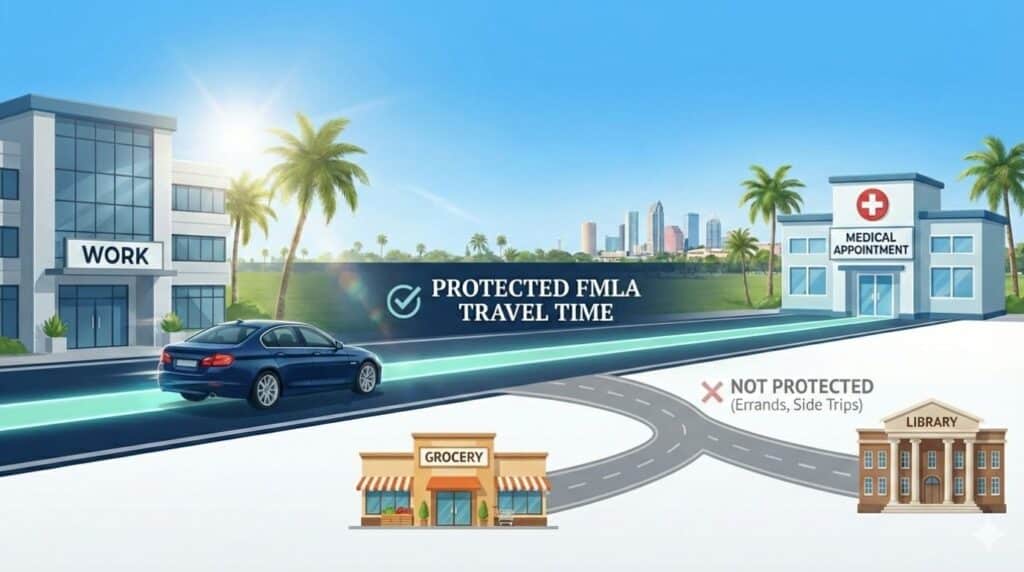
Earlier this month, the Department of Labor’s Wage and Hour Division issued an opinion letter confirming that FMLA leave includes travel time to and from medical appointments.
What does this mean for Florida workers? Let’s break it down.
What is the FMLA?
Enacted in 1993, the FMLA allows employees to take up to 12 weeks of unpaid, job-protected leave in 12 months for their own serious health condition or that of a family member (or 26 weeks for caring for a service member).
Who Can Take FMLA Leave?
The FMLA covers several situations:
- An employee has a serious health condition that prevents them from doing their job
- An employee needs to care for a family member with a serious health condition
- An employee is welcoming a new baby or adopted child
FMLA Eligibility Requirements
To qualify for FMLA protection, an employee must meet these requirements:
- Worked for their employer for at least one year
- Worked at least 1,250 hours in the prior 12-month period (about 24 hours per week)
- Their employer has at least 50 employees on the payroll within a 75-mile radius for at least 20 weeks in the current or previous year.
Is travel-time protected?
Questions of whether an employee’s travel time to and from medical appointments is protected under the FMLA have now been answered by the DOL. In its recent opinion letter, the DOL confirmed that employees can use FMLA leave not only for medical appointments related to their own or a family member’s serious health condition, but also for the time it takes to travel to and from those appointments. This means if an employee needs to leave work early to drive to a doctor’s appointment, the commute time counts as protected FMLA leave. Importantly, healthcare providers don’t need to estimate travel time on medical certification forms for the certification to be valid. However, the opinion clarifies that FMLA protection only covers travel directly related to medical care—side trips for errands like grocery shopping or library visits wouldn’t be protected. As the DOL states, employees may use FMLA leave to travel to or from medical appointments “whether or not the medical certification indicates the need for, time required, or other particulars of, such travel time.”
While DOL opinion letters are not binding on courts, this opinion letter provides important guidance on how the DOL will interpret and enforce the FMLA in situations involving travel time to medical appointments. The letter demonstrates the agency’s position that travel time is protected under the Act and signals how the DOL will likely handle complaints involving similar circumstances.
Examples of travel time under the FMLA according to the DOL
When scheduling treatment for your serious health condition at 4:00 pm.
- Any time in treatment before 5:00 pm
- Travel time to the appointment
When requesting intermittent leave to take a relative to treatment for a serious health condition.
- Time spent picking up, traveling your relative to and from appointment, dropping off
- Time spent waiting for the appointment to begin and end
- Time spent traveling from and back to work
When taking leave to help your child with a serious health condition who needs care on a trip.
- Time needed to travel to, from, and assist seriously-ill child
When taking leave once a week for two-hour physical therapy for a serious health condition.
- Time needed to travel to, from, and attend physical therapy
What does this mean for Florida workers?
The FMLA prohibits employers from interfering with, restraining, or denying an employee from exercising their rights protected by the FMLA.
How to Pursue FMLA violations?
- Employees who experience FMLA violations have options for seeking relief. An employee can file a complaint with the Department of Labor’s Wage and Hour Division, which will investigate the claim and may take action against the employer.
- Alternatively, employees can file a lawsuit directly in court. It’s important to act quickly—employees generally have two years from the date the employee knew or should have known of the violation to file a lawsuit, or three years if the violation was willful.
Because filing a complaint with the DOL does not stop this time limit from running, employees who believe their FMLA rights have been violated should not delay in pursuing an FMLA claim.
If you are a Florida worker who believes your employer has denied or interfered with your leave under the FMLA, including denying coverage for travel time to medical appointments, you should contact a qualified attorney in your state to discuss your claims.
If you are having issues with FMLA or have questions, consult experienced employment lawyers at Sass Law Firm. Sass Law Firm has over 35 years of experience protecting Tampa Bay workers in FMLA and employment disputes.