
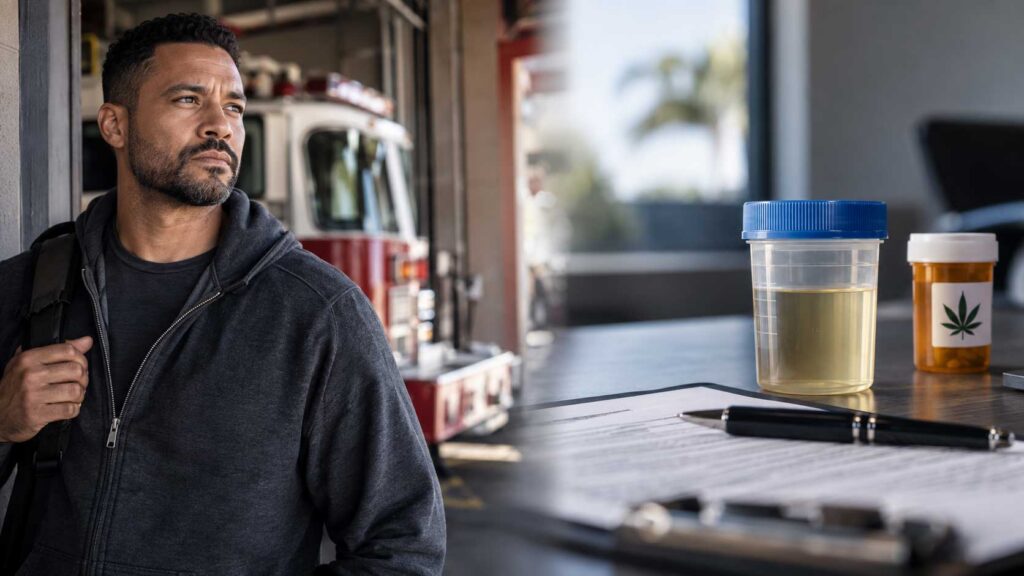
If you use medical marijuana for a disability, a Florida court just ruled your employer doesn’t have to accommodate it — even if you only use it off the clock.
In Hillsborough County v. Giambrone, No. 2d2025-0115, 2026 WL 2178829 (Fla. 2d DCA 2026), the Second District Court of Appeal heard a dispute between Hillsborough County and firefighter-paramedic Angelo Giambrone. Giambrone took a random drug test in 2019, and the County received a positive result for marijuana. In response, the County placed him on unpaid administrative leave despite the County’s own admission that there was no evidence Giambrone was ever impaired or used marijuana on the job. In fact, he had been promoted in 2018 while using medical marijuana off duty, with a clean performance record throughout his employment.
Giambrone held a medical marijuana card and used medical marijuana while off duty. He sued the County after it refused to accept his card as an excuse for the positive test, arguing that the County was required to accommodate his medical marijuana use as a reasonable accommodation under the Florida Civil Rights Act (FCRA). The trial court agreed, ordering the County to accommodate employees who hold medical marijuana cards for off-duty use.
The appeals court disagreed.
Why the Court Ruled Against Giambrone
The court’s decision centered on the County’s collective bargaining agreement and drug-free workplace policy. That agreement barred firefighters from using drugs “at any time while employed,” with exceptions only for alcohol and prescribed medications. It also defined “impaired” to include a positive drug test. Under this language, a first confirmed positive test required treatment, leave, and a negative follow-up test before an employee could return to work.
Giambrone argued that his medical marijuana card should count as a “prescription.” In a 40-page opinion, the court disagreed. It explained that Florida’s medical marijuana system works through physician certification and licensed treatment centers, not through the traditional pharmacist-filled prescription process. Giambrone also argued that marijuana should count as a “nonprescription” medication instead, comparable to an over-the-counter drug like ibuprofen that anyone can buy without a doctor’s involvement. The court rejected that too. Unlike a true over-the-counter drug, medical marijuana still requires a doctor’s certification and a state-issued card, so it isn’t available to the general public the way the contract’s definition required.
The court went a step further, rejecting the broader argument that Florida’s medical marijuana law, combined with the FCRA’s reasonable accommodation requirement, forces employers to permit off-duty use. Florida’s medical marijuana statute specifically preserves an employer’s right to maintain a drug-free workplace program. In other words, neither statute gives employees a basis to demand accommodation for marijuana use or to sue for wrongful termination or discrimination over it. As a result, the appeals court struck down the trial court’s countywide protection for employees who test positive despite holding a valid medical marijuana card.
What This Means for Workers
A medical marijuana card may not save your job after a positive drug test — but the outcome really depends on the specific rules that cover you. This case turned on the wording of one collective bargaining agreement (CBA), the contract between Hillsborough County and the firefighters’ union. That contract defined words like “prescription” and “impaired” in a way that left medical marijuana out. Because the court’s ruling rested on that specific contract language, a different result is possible under a different CBA, or under a drug-free workplace policy that defines “prescription” differently (for example, one that specifically covers medical marijuana cardholders). Employees who are not covered by a CBA may still be able to challenge a termination or denial tied to medical marijuana use, but it remains an uphill battle, especially in safety-sensitive roles — such as firefighting, emergency response, and any job involving vehicle operation. This analysis reflects the current state of the law specifically under the Florida Civil Rights Act. It does not account for recent federal reclassification efforts affecting marijuana’s legal status, and it is not an evaluation of an employee’s rights or an employer’s obligations under the Americans with Disabilities Act.
The Bottom Line
Medical marijuana may be legal under Florida law, but that doesn’t automatically protect your job. What actually decides the outcome is the exact wording of your CBA or your employer’s drug-free workplace policy — especially how it defines “prescription.” Different wording could lead to a different result than this case. Employees should not assume a medical marijuana card overrides an employer’s drug testing policy.
Florida Medical Marijuana and Employment Frequently Asked Questions
Not necessarily. In Hillsborough County v. Giambrone, a Florida appeals court ruled the employer didn’t have to accommodate an employee’s off-duty medical marijuana use under the Florida Civil Rights Act. The court also confirmed that Florida’s medical marijuana law lets employers keep enforcing a drug-free workplace policy. Similarly, the Americans with Disabilities Act has been interpreted not to require accommodation of medical marijuana because marijuana is classified as an illegal drug under federal law. However, recent attempts through the DEA to reclassify marijuana may have a different outcome in the future.
Not automatically. A valid card won’t necessarily excuse a positive test. It depends on if your employer has a drug free workplace policy and the exact wording of your employer’s drug-free workplace policy or union contract. In Giambrone, it didn’t.
The case turned on how the firefighters’ union contract defined “prescription” and “nonprescription medication.” The court held medical marijuana was neither: it’s not a pharmacist-filled prescription under Florida law, and it’s not an over-the-counter drug available to the general public. Since it didn’t fit either category, it wasn’t a “prescribed medication” under the contract, so the county’s drug-testing rules applied in full.
Yes, in many cases. Florida’s medical marijuana law specifically protects an employer’s right to maintain a drug-free workplace policy, including prohibition against medical marijuana. In Giambrone, the employee’s card didn’t override the county’s drug-testing rules.
Yes. The exact wording matters a lot. In Giambrone, how the contract defined “prescription” and “impaired” was central to the outcome. Workers under a different contract could see a different result if their agreement defines these terms differently.
Possibly. This case turned on one specific contract’s language. A different agreement or policy, such as one that explicitly addresses medical marijuana cardholders or defines “prescription” more broadly, could produce a different result.